Advanced CCDA Workstation
For Development & Testing
$CCDA Viewer is a planned desktop utility for viewing and inspecting C-CDA XML documents during development, testing, debugging, and technical review.
It is being explored for healthcare IT, interoperability, migration, QA, and data teams that need to understand document structure, coded sections, templates, and XML content using synthetic, redacted, or organization-approved test data.
These planned early-access tools are intended for development, testing, debugging, and technical review. They are not intended for clinical decision-making. Use synthetic or redacted data and follow your organization’s policies.
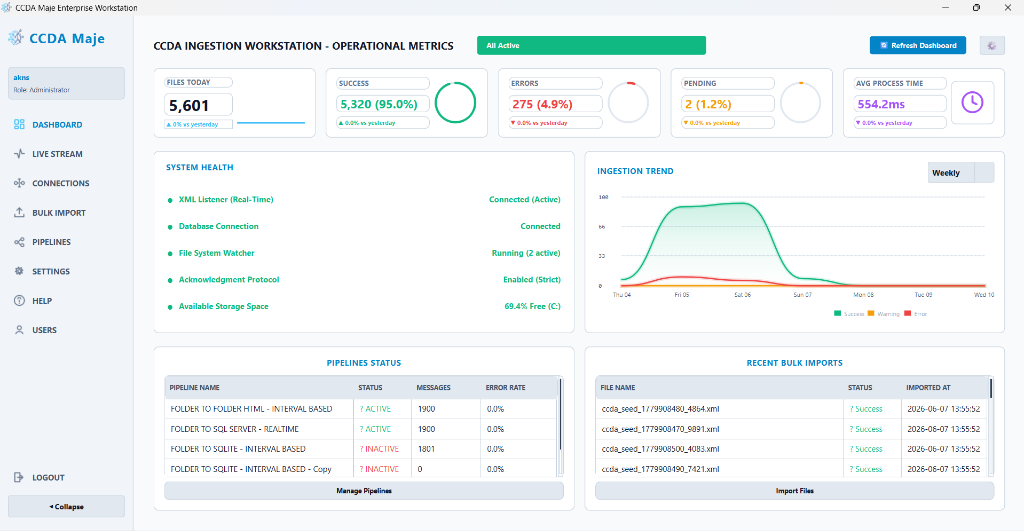
Early build interface preview. Final features, layout, availability, and packaging may change before release.
Exploratory Capabilities, Local Performance
$CCDA Viewer is being designed for high-volume local C-CDA processing workflows. Bypass external runtimes and analyze data locally.
Structured CCDA Viewer
Designed to help render clinical sections, medication tables, vital charts, and provider metadata into a human-friendly layout.
Clinical Section Analysis
Intended to help analyze narrative tables and structured data to isolate coded elements.
Medication & Allergy Parsing
May help extract RXNorm and NDDF drug identifiers, allergy criticality levels, and dates from deep XML nodes.
Database Ingestion
May help connect to local database engines (PostgreSQL, SQL Server, MongoDB) to preview writing clinical tables.
Bulk Document Processing
Intended to review directories containing batch CDA, CCD, and C-CDA XML files.
XML Structure Inspection
Includes a tree hierarchy inspector showing raw XML attributes, namespaces, and structure review messages.
Data Extraction Workflows
Build custom mapping schemas to pull only selected data points into CSV files or JSON streams for review before downstream use.
Analytics Preparation
Intended to help review clinical timelines and filter sections for technical review.
Built for Healthcare
Data Review
$CCDA Viewer is being explored as a desktop utility for healthcare IT, interoperability, migration, and data teams that need a faster way to inspect C-CDA XML documents during development, testing, debugging, and technical review.
It is intended to help teams review document structure, coded sections, XML content, and interoperability issues using synthetic, redacted, or organization-approved test data.
Clinical Document Inspection
Rapidly open and verify patient summaries received from external care facilities, validating sections visually in seconds.
CCDA Ingestion Pipelines
Preview data loads into Postgres database models to help understand custom tables.
EHR Interoperability Workflows
Bridges interoperability gaps by checking validation and schema issues locally before releasing to core integration systems.
Data Migration Projects
Cleanse and transition large patient histories stored in older CCDA archives during EHR platform transitions.
Clinical Analytics Preparation
Prepare structured data sets extracted from patient summaries for reporting, reconciliation, migration, and downstream analytics.
Healthcare ETL Workflows
Preview advanced local extraction and parsing tasks without complex enterprise infrastructures.
Why Teams May Use $CCDA Viewer
Local-First Review Architecture.
Lightweight Local Footprint.
Healthcare data review workflows often do not require massive cloud services and server overhead just to view and parse clinical records. CCDA Viewer is being explored as a natively compiled tool intended to run offline on Windows, macOS, and Linux, designed for responsive local review and a local-first processing model.
Local Desktop Execution
CCDA Viewer runs locally in your local environment. Clinical documents are not intentionally uploaded to Efneze servers during normal application use, helping maintain local control over sensitive healthcare data.
No Bloated Dependencies
Planned as a lightweight desktop package that may not require heavy database backends, Java runtimes, or cloud services for review workflows.
{
  "parser_engine": "native_ccda_v2",
  "document_types": ["CCD", "PHR", "DISCHARGE"],
  "extraction_rules": {
    "sections": ["problems", "medications", "allergies", "vital_signs"],
    "code_mappings": {
      "rxnorm_validation": true,
      "loinc_validation": true
    }
  },
  "ingestion_targets": {
    "postgres_loader": {
      "enabled": true,
      "connection_string": "env_var(CLINICAL_DB_URL)",
      "batch_size": 250,
      "table_mappings": {
        "record_target": "patients",
        "problems": "diagnoses",
        "medications": "prescriptions"
      }
    }
  }
}Explore Labs Tools
Desktop tools offer local data inspection to help view, parse, and review clinical document structures during technical work.
CCDA Viewer FAQ
What is CCDA Viewer?
${SiteConfig.products.ccda.name} is a planned desktop utility designed for development, testing, debugging, and technical review. It is intended to help teams inspect Consolidated Clinical Document Architecture (C-CDA) XML files, extract sections, and preview ingestion workflows.
Who is it designed for?
It is designed specifically for data engineers, Health IT developers, data analysts, and technical integration teams who handle clinical documents daily and need something more robust, secure, and automated than basic web-based viewers.
Does it support bulk processing?
${SiteConfig.products.ccda.name} is planned to include a parsing engine designed to read batch XML files. It is intended to help parse, validate, and preview loading batches of files into your local databases.
Can it help with database ingestion?
The tool is being explored to include loaders to preview mapping parsed clinical summaries into relational databases (such as PostgreSQL, SQL Server) and NoSQL stores by matching XML elements to flat schemas.
Is it suitable for clinical integration teams?
It is intended to help healthcare integration operations. Whether you are migrating EHR data, building HL7 clinical data warehouses, or preparing analytics-ready patient cohorts, ${SiteConfig.products.ccda.name} may help provide technical review utility before deeper integration or migration work.
Is ${SiteConfig.products.ccda.name} clinical decision support software?
No. ${SiteConfig.products.ccda.name} is not an EHR, diagnostic system, treatment recommendation tool, or clinical decision support system. It is an offline interoperability utility for C-CDA inspection, parsing, validation, transformation, migration, and operational data loading.
Does Efneze need access to customer PHI for support?
Efneze does not intentionally require PHI for standard support. Support requests should use synthetic, redacted, or organization-approved test data. Users should avoid submitting PHI, credentials, or sensitive production data unless explicitly permitted by their organization’s policies.
Who is responsible for validating mappings and loaded output?
Customers are responsible for reviewing and validating mappings, transformations, destination schemas, and loaded outputs before using the data in downstream or organization-approved workflows.