
Technology Comparisons in Healthcare Data Systems
Kafka vs Traditional ETL for Healthcare Ingestion
When architecting ingestion pipelines for healthcare, data engineers frequently debate between Apache Kafka and traditional ETL tools (like Informatica or Talend).
Kafka is commonly evaluated for event-streaming use cases where low-latency routing, replay, and event durability are important considerations. It may be well-suited for live ADT (Admission, Discharge, Transfer) feeds where timely routing matters. Conversely, Traditional ETL may be better suited for bulk claims processing (e.g., 837 files), where complex historical joins and overnight batch processing are acceptable. For healthcare data environments, the right architecture depends on data volume, latency needs, interoperability requirements, governance, operational complexity, and organizational policy. Modern architectures often explore a hybrid approach.
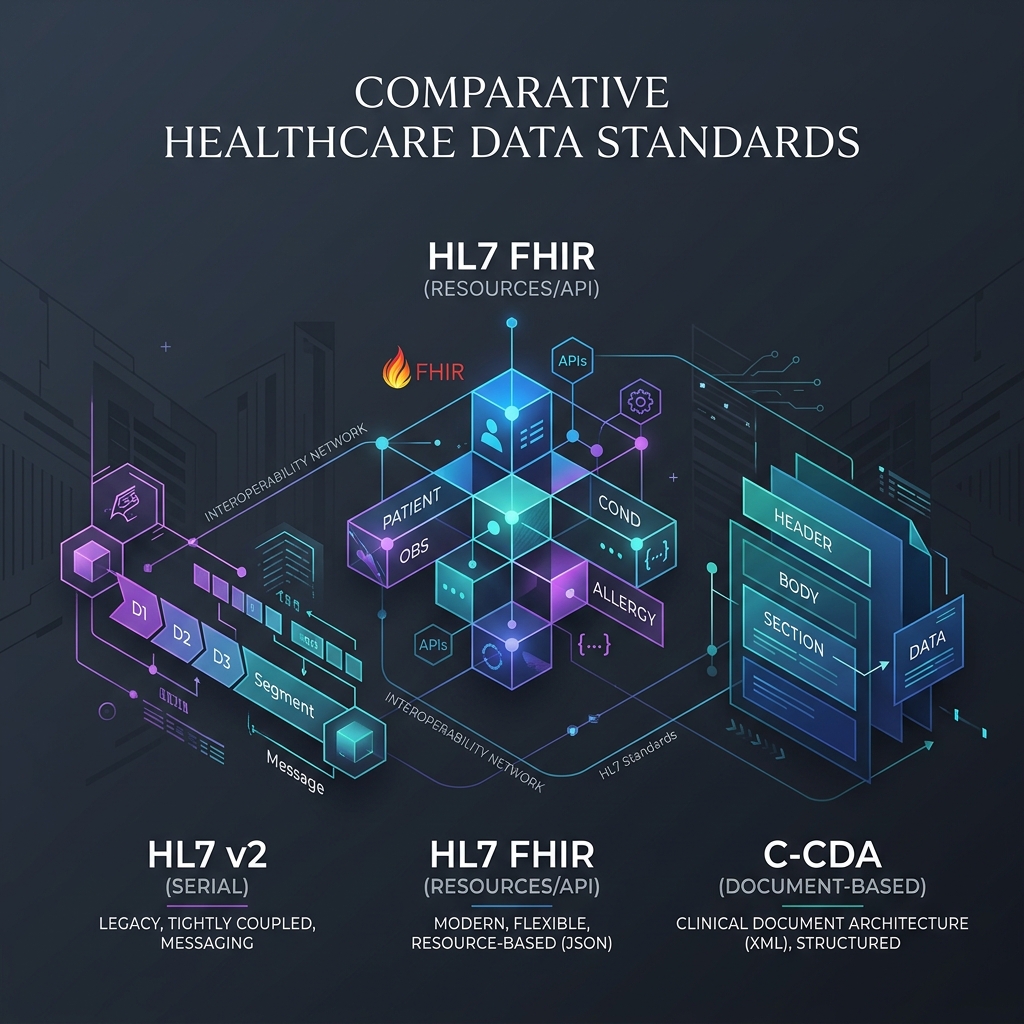
FHIR vs HL7 v2 vs CCDA
Understanding the dominant data formats is essential for any healthcare interoperability project.
- HL7 v2: The legacy standard. It is pipe-delimited, heavily customized per hospital, and event-driven. It's fast but lacks strict semantic consistency.
- C-CDA (Consolidated Clinical Document Architecture): An XML-based standard used primarily for exchanging complete medical summaries (e.g., when a patient changes doctors). It is comprehensive but difficult to parse into discrete data points.
- FHIR (Fast Healthcare Interoperability Resources): The modern, RESTful standard using JSON. It provides discrete data resources (Patient, Observation, Condition) and is the mandated future of US healthcare interoperability under the 21st Century Cures Act.
Data Warehouse vs Data Lake vs Lakehouse
Where should you store this data?
A Data Warehouse requires strict schema-on-write, making it robust for financial reporting but brittle for changing clinical data models. A Data Lake offers schema-on-read, perfect for dumping raw HL7 messages, but querying can be slow and complex.
The Lakehouse architecture (using technologies like Databricks or Snowflake) is one approach organizations evaluate for healthcare. It may allow storing raw unstructured data (like clinical notes and images) alongside structured tables for FHIR data, potentially supporting both traditional BI reporting and machine learning workloads. The right fit depends on data governance, operational maturity, compliance requirements, and organizational constraints.
Practical Selection Framework
Use HL7 parsing when the source is a live interface feed, use the CCDA viewer when the source is a clinical document, and use the FHIR validatorwhen resources are being produced for APIs or analytics. The right architecture usually combines multiple standards rather than forcing one format to solve every workflow.
Frequently Asked Questions
Is Kafka better than traditional ETL in healthcare?
Kafka is commonly explored for near-real-time healthcare data workflows, while traditional ETL remains useful for scheduled batch workflows such as claims and warehouse loads.
How do FHIR, HL7 v2, and C-CDA differ?
HL7 v2 is a message standard, C-CDA is a clinical document standard, and FHIR is a resource/API standard.